The International Preschool Curriculum (IPC) is a comprehensive early childhood education program designed to provide a balanced approach to learning. It integrates various educational methodologies to cater to diverse learning styles and aims to develop key cognitive, physical, and social skills in young children.

IPC is renowned for its holistic approach to early childhood education, seamlessly integrating six key learning areas to foster comprehensive development in young learners.
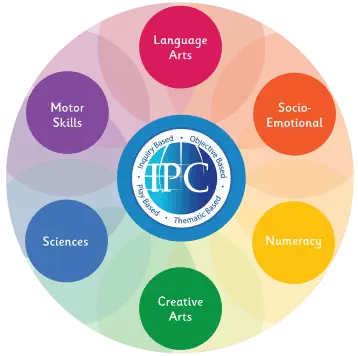
Each facet of the IPC curriculum, including language arts, numeracy, socio-emotional skills, creative arts, sciences, and motor skills, is thoughtfully designed to engage children in dynamic and interactive learning experiences.
Leveraging global research and integrating best practices from the world’s leading early childhood educators, the IPC curriculum promotes inquiry-based learning, active exploration, and social collaboration. The IPC method puts the child at the center of their educational journey, thus emphasizing meaningful engagement and socio-emotional development.
The International Preschool Curriculum (IPC) has established itself as a leading curriculum globally by promoting innovation, research, and quality in curriculum and educational practice.
IPC offers a comprehensive curriculum that integrates best practices from around the world. Its curriculum modules encompass diverse subjects such as language arts, mathematics, science, social studies, creative arts, physical development, and social-emotional learning.
IPC incorporates global perspectives into its curriculum, exposing children to diverse cultures, languages, and global issues. This global awareness fosters cultural competence, empathy, and respect for diversity among young learners, preparing them to thrive in an interconnected world.
IPC prioritizes educators' professional development through specialized training programs and ongoing support. By equipping educators with the knowledge, skills, and resources needed to implement the curriculum effectively, IPC ensures high-quality educational experiences that meet the needs of diverse learners.
IPC recognizes the importance of parental involvement in children's education and promotes collaboration between educators and parents. Through workshops, communication tools, and family engagement activities, IPC strengthens the partnership between home and school, fostering a supportive learning environment for children.
In today’s rapidly evolving world, the demand for skills in science, technology, engineering, the arts, and mathematics (STEAM) is more crucial than ever. Recognizing this, the International Preschool Curriculum (IPC) has integrated STEAM education into its curriculum to nurture young learners’ natural curiosity and creativity while equipping them with the skills needed for future success.

IPC’s curriculum is designed to be interdisciplinary, meaning that STEAM subjects are not taught in isolation but are integrated into various aspects of the learning experience. For example, a lesson on building a simple machine might incorporate principles of physics (science), measurements (mathematics), and creative design (arts), allowing children to see the connections between different fields.
IPC emphasizes experiential learning, where children engage in hands-on activities and experiments. These activities are carefully crafted to be age-appropriate and encourage exploration and experimentation. Whether it’s creating art with a focus on symmetry, building simple structures, or exploring the natural world, these activities help children develop a practical understanding of STEAM concepts.
IPC incorporates project-based learning (PBL) into its STEAM approach, where children work on projects that require them to apply knowledge from various STEAM disciplines. For example, a project might involve designing and building a model city, which would require understanding architectural principles (engineering), planning (mathematics), and environmental impact (science). PBL encourages collaboration, creativity, and the application of knowledge in real-world contexts.
Technology is seamlessly integrated into the IPC curriculum to enhance learning. Children are introduced to age-appropriate digital tools and resources that support their exploration of STEAM concepts —for example, using educational software to create digital art or simple coding activities to introduce the basics of computer science. These tools not only make learning more engaging but also help children become comfortable with technology from an early age.
The “A” in STEAM represents the arts, which IPC believes is crucial for fostering creativity and innovation. Artistic expression is woven into the curriculum through activities like drawing, music, dance, and drama. These activities allow children to express their understanding of scientific concepts creatively, such as using dance to demonstrate the concept of movement or creating art that reflects patterns found in nature.
Incorporating STEAM into the curriculum is a cornerstone of IPC's approach to early childhood education. By blending science, technology, engineering, the arts, and mathematics into a cohesive learning experience, IPC not only prepares children for future success but also fosters a lifelong love of learning.
The IPC student is expected to achieve a minimum standard in each of the six content learning areas. The IPC believes that children will develop at varying paces and, therefore, structures its learning objectives into three distinct levels.

Lorem ipsum dolor sit amet, consectetur adipiscing elit. Independent thinkers develop the ability to question, reason, and make thoughtful decisions on their own.
Unlike conventional models that often rely on rote memorization and structured teacher-led instruction, the IPC embraces thematic, inquiry-based learning that encourages active exploration and critical thinking.

Traditional learning often follows a rigid, teacher-directed approach, while the IPC emphasizes a dynamic, child-centered curriculum.
IPC uses a blend of play-based and inquiry-based learning methods, contrasting with the more didactic, lecture-based methods typical in traditional settings.
In IPC, teachers act as facilitators or guides, whereas in traditional models, teachers are often the primary source of knowledge and authority.
IPC uses ongoing, formative assessments to monitor development, focusing on individual progress, while traditional models may rely heavily on standardized testing.
The IPC Infant and Toddler Curriculum was specifically designed to engage and educate the youngest of children ages 3–36 months.
Through a variety of daily activities, each of the five senses is engrossed, and young children are introduced to the skills and knowledge necessary for their development. The Infant and Toddler Curriculum is divided into 36 Thematic Units, from The Circus to Dinosaurs. Each of the 36 units’ activities is based on the IPC’s Six Content Learning Areas.
DOWNLOADThe IPC Preschool Curriculum is an educational framework designed to promote early childhood development through a thematic, play-based approach. It emphasizes hands-on learning experiences, fostering cognitive, social, emotional, and physical growth in children.
The curriculum integrates a variety of subjects, such as language, math, science, and creative arts, with a strong focus on global awareness and cultural diversity. It encourages exploration, critical thinking, and collaboration among young learners, preparing them for future academic success in a nurturing and engaging environment.
With over 20 units, the IPC Preschool Curriculum was developed to be fun and engaging.
DOWNLOAD